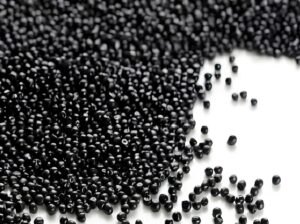
The choice between TPE vs EPDM for an extruded gasket or a technical plastic profile directly influences performance, service life, production process and the possibility of integrating the component into the final product.
For many years, EPDM rubber (Ethylene Propylene Diene Monomer) has been one of the most widely used solutions for industrial gaskets, window systems and applications exposed to weather conditions, thanks to its high resistance to UV radiation, ozone and ageing.
Today, TPE thermoplastic elastomers (Thermoplastic Elastomers) represent an advanced technological solution because they combine rubber-like elasticity with the production advantages of plastics: continuous extrusion, co-extrusion, aesthetic customization, dimensional accuracy and material recovery possibilities.
The correct choice does not depend on which material is universally better, but on which solution best matches the characteristics and requirements of the specific project.
In general:
- EPDM remains suitable for applications requiring high outdoor performance, ozone resistance and high operating temperatures.
- TPE is the ideal solution when customization, rigid-soft co-extrusion, aesthetic requirements, dimensional precision and material recovery are important.
Mavis develops customized TPE extruded gaskets for industrial applications, furniture, technical lighting, window systems and special components, selecting the most suitable material according to project requirements.
Contents
- TPE vs EPDM: quick comparison between thermoplastic elastomers and traditional rubber
- What is TPE?
- What is EPDM?
- Technical differences between TPE and EPDM
- Thermal resistance, UV radiation, ozone and chemical resistance
- Compression set and elastic recovery: long-term material behaviour
- TPE co-extrusion: when the project goes beyond EPDM limitations
- TPE for aesthetic design, furniture and technical lighting
- Sustainability and recyclability of thermoplastic elastomers
- When to choose TPE and when to choose EPDM
- Industrial applications of TPE extruded gaskets
- FAQ about TPE vs EPDM
TPE vs EPDM: quick comparison between thermoplastic elastomers and traditional rubber
Thermoplastic elastomers (TPE) and EPDM rubber belong to the elastomer family, but they have different production processes and design characteristics.
EPDM is a vulcanized synthetic rubber. The chemical vulcanization process provides elasticity and long-term resistance, but makes the material non-remeltable.
TPE is a thermoplastic elastomer that can be processed through extrusion and co-extrusion technologies. This characteristic provides greater design flexibility and allows different materials to be integrated into the same profile.
Comparison table: TPE vs EPDM
| Technical feature | EPDM | TPE |
|---|---|---|
| Production technology | Vulcanization | Extrusion and co-extrusion |
| Geometrical customization | Good | Very high |
| Rigid-soft co-extrusion | Limited | Possible |
| Material recovery | Difficult | Easier |
| Available colours | Mainly black | Wide range of colours and transparencies |
| Dimensional accuracy | Good | Very high |
| Functional integration | Limited | High |
What is TPE (Thermoplastic elastomer)?
TPEs, or thermoplastic elastomers, are materials that combine the elastic properties of rubber with the processability typical of plastics.
Unlike vulcanized rubbers, TPEs can be heated, shaped and processed again through industrial technologies such as extrusion and co-extrusion.
This characteristic allows manufacturers to produce:
- continuous extruded gaskets;
- customized flexible profiles;
- rigid and soft components integrated into the same product;
- coloured or transparent profiles;
- solutions using recovered or regenerated materials.
Main types of TPE used for extruded gaskets
| Material | Main characteristics | Typical applications |
|---|---|---|
|
TPU Thermoplastic Polyurethane |
High mechanical resistance, abrasion resistance, resistance to oils and impacts | Technical lighting, machinery, industrial profiles |
|
TPV Thermoplastic Vulcanizate |
Resistance to UV radiation, ozone, temperature and ageing | Window systems, automotive, outdoor applications |
| SEBS | Softness, elasticity, soft-touch effect | Furniture, decorative components, aesthetic applications |
| SBS | Good flexibility and grip | Less demanding technical applications |
What is EPDM (Ethylene propylene diene monomer)?
EPDM is a vulcanized synthetic rubber that has been used for many years in the production of technical gaskets thanks to its reliability in demanding environmental conditions.
The main characteristics of EPDM are:
- excellent resistance to UV radiation;
- high ozone resistance;
- good stability against weather conditions;
- good long-term elasticity;
- temperature resistance generally between approximately -50 °C and +150 °C.
Due to these characteristics, EPDM is still widely used today in industrial applications, construction, window systems and technical components.
However, being a thermosetting elastomer, EPDM has some design limitations:
- it cannot be remelted and recovered as easily as a thermoplastic material;
- it does not allow true co-extrusion with rigid materials;
- it requires a vulcanization production process;
- it generally offers fewer aesthetic possibilities compared with TPE.
Technical differences between TPE and EPDM
The main difference between TPE vs EPDM concerns the behaviour of the material during the production process.
EPDM is processed through vulcanization, an irreversible chemical reaction that provides elasticity and resistance but prevents further thermoplastic processing.
TPE is processed through thermoplastic extrusion: the material is heated, shaped and can be integrated with other polymers during the production process.
Technical comparison: TPE vs EPDM
| Technical aspect | EPDM | TPE |
|---|---|---|
| Production process | Chemical vulcanization | Thermoplastic extrusion |
| Possibility of modification after production | Limited | Higher thanks to thermoplastic behaviour |
| Integration with other materials | Limited | High through co-extrusion |
Thermal resistance, UV radiation, ozone and chemical resistance
The choice between TPE and EPDM must always consider the real operating environment of the gasket or extruded profile.
Resistance to weather conditions
EPDM maintains an important historical advantage in outdoor applications thanks to its high resistance to:
- UV radiation;
- ozone;
- rain and humidity;
- climatic variations.
Some TPE formulations, particularly TPV, can now achieve comparable performance and are used as a technical alternative to EPDM in several industrial sectors.
Chemical resistance
The behaviour depends on the specific material formulation.
- EPDM: high resistance to water, steam, weather conditions and many chemical agents.
- TPU: excellent resistance to abrasion, oils and greases.
- SEBS: suitable for indoor applications where aesthetics and comfort are important.
- TPV: a balanced solution for outdoor applications.
Compression set and elastic recovery: long-term material behaviour
One of the most important aspects in gasket design is compression set, meaning the ability of the material to recover its original thickness after being compressed for a long period.
A gasket with poor elastic recovery may lose effectiveness, causing:
- loss of sealing performance;
- water infiltration;
- vibration problems;
- noise.
Modern TPE formulations can provide excellent elastic behaviour over time, allowing reliable solutions for many industrial sectors.
TPE co-extrusion: when the project goes beyond EPDM limitations
One of the main advantages of thermoplastic elastomers is the possibility of creating co-extruded profiles by combining different materials in the same component.
Mavis uses this technology to integrate:
- rigid materials such as PC (polycarbonate) and PMMA (polymethyl methacrylate);
- soft materials such as TPU, TPV and other thermoplastic elastomers.
Example: LED profiles with integrated gasket
In the technical lighting sector, it is possible to create co-extruded profiles combining:
- transparent polycarbonate (PC) for light diffusion;
- transparent TPU for sealing function.
The result is an LED profile with:
- improved protection against dust and humidity;
- reduction of assembled components;
- simpler installation;
- better final aesthetics.
TPE for aesthetic design, furniture and technical lighting
Today, a gasket is not only a functional component, but can also become an integral part of the final product design.
TPE materials allow manufacturers to achieve:
- customized colours;
- soft-touch surfaces;
- aesthetic finishes;
- transparent materials.
They are particularly suitable for:
- furniture profiles;
- gaskets for cabinet doors;
- LED profiles;
- industrial design components;
- soft-touch elements.
Sustainability and recyclability of thermoplastic elastomers
Sustainability has become an increasingly important factor in industrial design and product development.
TPE materials offer significant advantages:
- possibility of recovering production waste;
- reduction of manufacturing waste;
- compatibility with circular economy strategies;
- possibility of using formulations containing recycled materials.
This aspect is important for companies that must meet environmental criteria, CAM requirements and material traceability needs.
When to choose TPE and when to choose EPDM?
Choose EPDM when:
- the application is strongly exposed to weather conditions;
- very high operating temperatures are required;
- specific aesthetic customization is not necessary;
- a traditional solution fully satisfies the project requirements.
Choose TPE when:
- a customized extruded gasket is required;
- co-extrusion of different materials is needed;
- rigid and soft components must be integrated;
- colours, transparencies or aesthetic finishes are important;
- high dimensional accuracy and continuous production are required;
- the project considers recyclability and sustainability.
Industrial applications of TPE extruded gaskets
TPE extruded gaskets and profiles are used in many industrial sectors:
- technical lighting and LED profiles;
- furniture and furniture manufacturing;
- window systems;
- household appliances;
- industrial refrigeration;
- automotive applications;
- industrial machinery;
- anti-vibration profiles;
- edge protection profiles and sheet metal protection.
Why choose Mavis for TPE extruded profiles and gaskets
Mavis supports companies, engineers and designers in the development of customized technical profiles through an approach focused on solving complex design requirements.
The experience gained in plastic extrusion allows Mavis to transform technical requirements into industrializable components, optimizing materials, profile geometry and production processes.
Mavis supports customers throughout the different project phases:
- Application analysis: evaluation of operating conditions, required performance and working environment.
- Material selection: identification of the most suitable TPE according to elasticity, resistance, aesthetics and durability requirements.
- Profile design: development of the most effective geometry to achieve the required technical performance.
- Extrusion and co-extrusion: production of simple or complex profiles integrating different materials in the same component.
- Dimensional control: verification of profile characteristics to ensure compliance with project specifications.
The choice between TPE vs EPDM should always be based on a complete technical analysis considering application, operating environment, required performance and production process.
FAQ about TPE vs EPDM
What is the main difference between TPE and EPDM?
EPDM is a vulcanized synthetic rubber, while TPE is a thermoplastic elastomer processed through extrusion. The main difference concerns the production process: TPE offers greater design flexibility, co-extrusion possibilities and easier material recovery.
Can TPE replace EPDM rubber?
In many applications, yes. Some TPE formulations, such as TPV and TPU, are used as technical alternatives to EPDM when dimensional accuracy, continuous production and functional integration are required.
Is TPE resistant to weather conditions?
Yes. Some thermoplastic elastomers, particularly TPV, offer high resistance to UV radiation, ozone and outdoor environmental conditions, making them suitable for external applications.
When is it better to choose an EPDM gasket?
EPDM remains a valid choice when the component must operate in demanding environmental conditions, with strong exposure to weather conditions and high temperatures, without requiring specific aesthetic or functional customization.
Why use TPU in LED profiles?
Transparent TPU allows the creation of co-extruded profiles with polycarbonate, combining aesthetic function, light diffusion and component protection in a single element.
Are TPE gaskets recyclable?
Yes. Thanks to their thermoplastic nature, many TPE formulations can be recovered and reprocessed more easily compared with traditional vulcanized rubbers.
Which TPE materials are used for extruded profiles?
The TPE family includes different formulations. TPU, TPV, SEBS and SBS are selected according to project requirements, such as mechanical resistance, elasticity, softness, transparency or resistance to external conditions.
Does Mavis manufacture customized TPE extruded profiles?
Yes. Mavis develops customized extruded profiles and gaskets starting from technical drawings, samples or customer specifications, supporting companies in selecting the most suitable material and production technology.
Request a consultation for your TPE extruded profile
Mavis develops customized TPE extruded gaskets and profiles for industrial applications, furniture, technical lighting and specialized sectors.
Starting from technical drawings, samples or project specifications, we help companies and designers identify the most suitable material and production technology to obtain reliable and industrializable components.
For technical advice or information, request a free quotation for plastic profiles and gaskets by completing the form.
Request a technical consultation