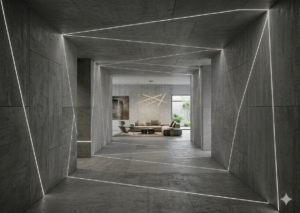
In the modern lighting engineering sector, the perceived quality of a LED system is no longer defined solely by Lumens, but by the optical management of the light source. LED diffusers and light diffusing polymers now represent the gold standard for transforming point-like light into a seamless visual experience, ensuring high luminous transmission and compliance with the aesthetic demands of the global market.
In this technical deep dive:
- 1. Why the LED diffuser is a critical optical component
- 2. The value of PC diffusers: performance and durability
- 3. Technical table: properties of light diffusing polymers
- 4. The Mavis experience: precision-engineered assembly
- 5. Versatilità: finishes and shapes in the lighting industry
- 6. FAQ on LED diffusers and diffusing polymers
Why the LED diffuser is a critical optical component?
The role of a diffuser is not merely to cover the strip, but to act as a corrective lens that delivers luminous uniformity. One of the primary limitations of LED sources is the unpleasant, typically dot-like aesthetic effect known as hot spots. Without a proper diffuser profile, the eye perceives individual diodes as distinct glare points, fragmenting the light line and causing “multiple shadowing”—a critical issue in retail and technical lighting environments.
Utilizing high-quality LED diffusers and profiles allows for the conversion of concentrated light into a continuous radiant line while maintaining a high color rendering index. At Mavis, we use diffusing polymers enhanced with reflective micro-particles (TiO2 or spherical diffusers) that facilitate internal refraction: the light does not pass “straight through” but is dispersed uniformly, maintaining a light transmission that often exceeds 80%, ensuring energy efficiency and visual comfort. This prevents glare and eye strain by lowering the UGR (Unified Glare Rating), ensuring compliance with UGR <19 (EN 12464-1). Our PC diffusing polymers meet ASTM D1003 (haze >95%) and EU RoHS/REACH standards, ideal for custom LED covers in retail and industry.
The value of PC diffusers: performance, Haze, and durability
The choice of materials for a LED diffuser defines the product’s service life. LED-grade polycarbonate (PC) is the preferred material due to its unique combination of mechanical and optical properties.
- Diffusion degree (Haze): our diffusing compounds are engineered to maximize the Haze value, ensuring the light source remains invisible even in ultra-slim profiles where the distance between the LED and the screen is minimal.
- Thermal stability (VICAT): although LEDs are a “cold” light source, heat accumulation within the profile can stress the plastic. Our PC diffuser maintains a high VICAT value, preventing warping or deformation.
- Resistance to photo-degradation and photo-oxidation: our LED covers are formulated to resist aging under luminous stress, preventing the yellowing and loss of transparency typical of non-UV-protected materials.
- Flammability class and safety: the optical polycarbonate we extrude is tested for flame retardancy according to UL94 (from V2 to V0). We also manufacture covers compliant with the European standard EN 45545-2 for railway vehicle lighting within the EU.
- Assembly versatility: the molecular density of our polycarbonate or high-impact PMMA allows for snap-fit (clip-on) mounting without the risk of cracking, ensuring a solid and precise fit within the aluminum profile.
Technical table: properties of LED diffusers and
light diffusing polymers
| Technical Specification | Reference Value (PC) | Performance Benefit |
|---|---|---|
| Diffusion degree (Haze) | > 95% | Elimination of point-like hot spots |
| Luminous transmission | 80% – 88% | Maximum Lumen/Watt system efficiency |
| Thermal stability (VICAT) | VST B/50 > 120 °C | Dimensional stability near high-power LEDs |
| Aging resistance | UV-resistant / Photo-stabilized | Low yellowing or photo-oxidation over time |
| Optical composition | Polymers with micro-particles | Optimized angular light distribution |
The Mavis experience: the secret of precision assembly
One of the greatest technical challenges is the coupling between the plastic diffuser and the aluminum profile. At Mavis, we know that the success of a linear lamp depends on mechanical clearances. Our technical department intervenes during the co-design phase to calculate perfect tolerances: a profile that is too wide will fall out, while one that is too narrow will warp. We design LED light covers—taking into account the coefficient of thermal expansion—that can be snap-mounted (clip-on) or slide-in with consistent fluidity. Using the right diffusing polymer also ensures an assembly that will not crack during mounting or subsequent mechanical processing, and will not shift during power cycles. A signature of quality that our clients value in professional projects.
Request a technical consultation
Versatility: finishes and shapes in the lighting industry
Every project requires a different type of diffusion. Beyond standard polycarbonate sheets, we produce diffusing extruded profiles with complex geometries:
- Shapes: round profiles for tubular effects, or angular for 45° architectural light cuts.
- Finishes: satin surfaces for soft light, or prismatic for glare control (UGR).
- Effects: ranging from high-coverage opal to diffusing transparent that “comes to life” only when the LEDs are switched on.
- Black cover: (black diffuser) matte black polycarbonate when off, translucent and luminous when the LEDs are on. A striking aesthetic effect for high-end design.
- Co-extrusions: we combine diffusing polymers with specialized TPE rubbers to ensure an IP 65/67 (IEC 60529) protection rating against water and dust. This advanced manufacturing approach confirms why our LED diffusers and light diffusing polymers are the preferred choice for extreme environmental conditions.
Custom lighting solutions: haze vs. LED distance
Mavis’s extrusion flexibility allows for the development of custom plastic profiles for complex linear systems. We analyze the distance between the LED and the screen to recommend the blend with the ideal Haze degree, resolving optical issues right from the prototyping phase.
FAQ on LED diffusers and light diffusing polymers
What is the minimum distance between a LED strip and the diffuser to avoid seeing dots?
It depends on the polymer’s Haze value. Thanks to our reflective micro-particles, Mavis diffusers allow for a 20% reduction in profile depth (LED-to-screen distance) compared to the standard, maintaining a seamless light line without visible hot spots.
Do PC diffusers yellow or undergo photo-degradation over time?
Unlike non-UV-protected materials, our LED polycarbonate diffusers are thermally stabilized and protected against photo-oxidation. Xenon arc tests (1000h, ISO 4892-2) confirm ΔYI <2.5, ensuring the diffuser maintains its original white point and light transmission even after thousands of operating hours.
Is snap-fit (clip-on) or slide-in mounting better?
Both are effective but require different diffuser profile designs. Snap-fit requires a resilient material like PC or high-impact PMMA. Our technical team assists clients in designing correct interlocks with co-design tolerances to ensure the LED diffuser is easy to install yet remains securely in place.
How should LED light covers be cleaned?
As stated in professional manuals, to maintain the quality of both sheets and plastic light diffusers, use an anti-static or soft cloth. Avoid harsh chemicals that could damage the polymer’s surface treatment.
Do Mavis diffusers help eliminate the “multiple shadow” effect?
Yes. Our diffusing polymer technology is designed to mix the luminous flux of individual LED chips within the material. This transforms the source into a uniform radiant surface, eliminating both hot spots and the overlapping sharp shadows typical of LEDs.
Is polycarbonate suitable for high-power thermal applications?
Absolutely. Our PC diffuser features a VICAT value exceeding 120°C. Even though LEDs emit “cold light,” the heat dissipated by the strip can be significant; polycarbonate ensures dimensional stability and prevents structural deformation.
PC vs. PMMA: which to choose for diffusing extrusions?
PC (polycarbonate) offers superior impact resistance (Izod 15 J/m) and heat resistance (Vicat >120°C), while PMMA offers high clarity but is brittle. We help you find the ideal compound for your slim LED profiles.
For technical consultation, information, or free quotes for custom-designed LED diffusing profiles, please fill out the form.